A mother’s reflection on raising a teenage daughter — through the lens of Robert Sapolsky’s Behave.
Welcome back, dear friends,
How have you all been? It’s been scorching hot lately here in Miri. I hope the weather is being a bit kinder to you! I recently stumbled upon a book recommendation on YouTube that really struck a chord with me. It inspired me to write this piece, using some of the book’s insights to help make sense of the turbulent teenage years my daughter and I navigated together. Happy reading!
INTRODUCTION
I didn’t fail. But I didn’t fully understand.
If you’ve ever sat in your car after school pickup, gripping the steering wheel while your teenage daughter rants in the passenger seat, you know “The Storm.”
Raising a teenager is never easy. Raising a teenage daughter? That’s a different level of challenge. Imagine navigating emotional crosswinds without a compass. And that’s putting it mildly. But raising a middle-child teenage daughter who also struggles with undiagnosed dyslexia? That, for me, was a tempest I neither predicted nor understood. Some days, it felt like a war I was losing before it even began.
My daughter is in her thirties now. I am in my sixties. The traces of those years are still there. In her, quietly; in me, loudly. The guilt of motherhood’s missed moments doesn’t dissolve with time. It just changes texture.
Then I read “Behave: The Biology of Humans at Our Best and Worst” by Robert Sapolsky. And something shifted.
“It wasn’t excuses I found in those pages. It was understanding. And understanding — even late — changes everything.”
Sapolsky explained everything. The science of the teenage brain provided me with something I had been lacking: understanding and clarity. The chaos of those years began to make more sense.
This post isn’t about being a perfect parent. It’s about what I wish I’d known about frontal cortices, emotional fireworks, and why “bad behavior” is rarely just bad parenting.
THE SCIENCE
What was actually happening inside her brain
Let’s strip away the dense terminology and sit with the essence.
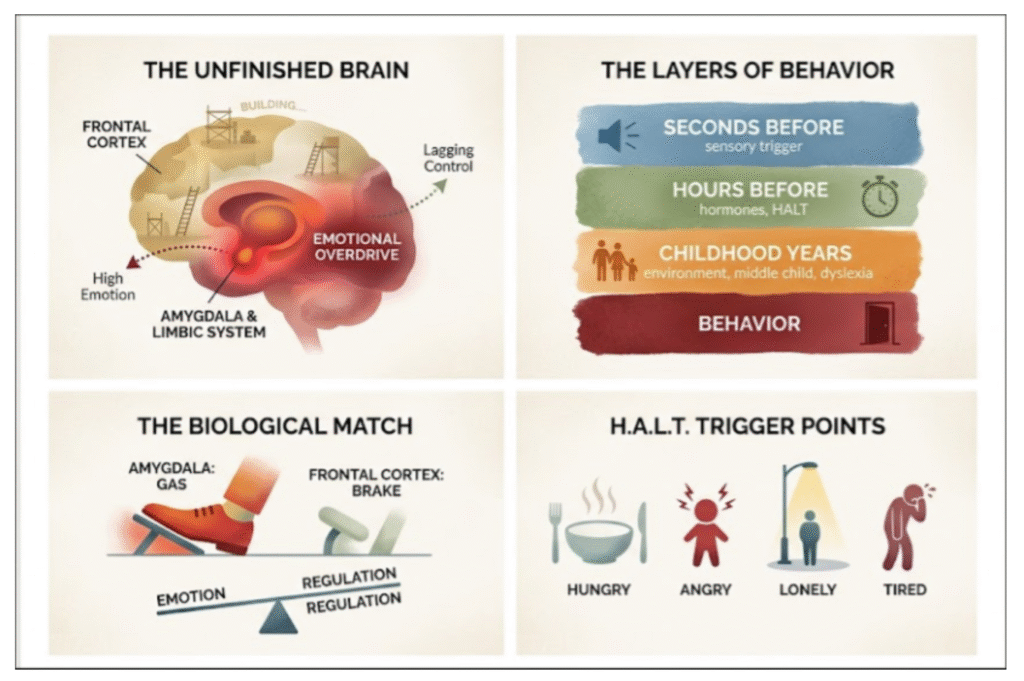
The teenage brain isn’t “broken” or defective. It is unfinished. Still under construction.
The Unfinished Frontal Cortex
This is the part of the brain responsible for impulse control, long-term planning, and emotional regulation. It is the last part of the brain to fully mature (sometimes not until their 30s!). That’s why teenage daughters can be brilliant one moment and explode over a misplaced phone charger the next. She literally can’t always do the harder thing.
The Overdrive Phase
While the “brakes” (frontal cortex) are still being installed, the “gas pedal” (the emotional and reward-seeking centers) is floor-to-floor. This creates a biological mismatch: high emotion, low control. Imagine a powerful engine paired with unreliable brakes. That is often the internal landscape of a teenager.
They are highly sensitive to social rejection, peer approval, emotional spikes. They are constantly on a thrill-seeking and risk-taking spree. These aren’t drama. They are really neurological storms
The Power of Biology + Context
Behavior is never just “bad parenting” or “middle child syndrome.” It is a cocktail of biology, family reality, and the specific moment. Her reaction at 4 p.m. may have roots planted years earlier. Or hours before. Or even seconds. Nothing exists in isolation.
For a teenage girl navigating an undiagnosed learning difference and the particular invisibility of the middle sibling, and with a mother stretched between a demanding — those layers were stacked high.
REFLECTION
Guilt meets understanding
Here’s the part I’ve never fully admitted in writing.
My professional life in those years was all-consuming. Finance in an oil & gas company meant long hours, late nights, financial closings where I simply did not come home in time to tuck them in. My children were largely raised by our maid.
When I finally noticed my two older children starving for presence, not just provision, I made the hardest professional decision of my life. I quit. Five years as a stay-at-home mother. That helped repair some of the early cracks but it didn’t erase them.
Then came the financial strain. One income. Tight budgets. Emotional strain I tried to hide but my daughter absolutely felt. So here I was, a mother struggling to be the best version of myself while secretly drowning.
And still, the fights came. Not always loud battles but often the “cool wars.” Silent rides home from school. Her ranting about everything and nothing. Me gripping the steering wheel, thinking, I feel like strangling her. But I didn’t. I told myself: I’m the adult. I have to behave like one.
Throughout every cold war, there was never a time I loved her less. We can be best friends again after. Even today. But the guilt? That stayed longer than I’d like to admit.
Sapolsky helps me see: guilt without context is just self-punishment. Understanding without excuses is the real repair.
After reading Sapolsky, I see my daughter differently now: She was a girl with a brain in construction, a self that felt unseen, a learning system that worked differently from what school demanded. And me? I was a mother doing my best amid my own invisible struggle. We were both, in different ways, operating with incomplete wiring.
FOR YOU, FELLOW MUM
What I wish I had known then
If you are walking this terrain now, perhaps these reflections may steady your steps:
Listen beyond the words.
When she says she feels unseen, resist the urge to correct. Instead, lean in: “Tell me more.” Validation is not agreement. It is an acknowledgment.
Understand the “Lag Time”
Realize that her brain literally cannot process the “harder thing” (like staying calm) as fast as yours can. Give her, and yourself, a 10-second buffer.
Choose your battles with care.
Her frontal cortex, still developing, may not always choose the harder, better thing. Knowing that, some battles are not worth the cost of the war. That dirty room? The eye roll? Choose wisely. Save your energy for safety, respect, and connection.
Remember HALT.
Hungry. Angry. Lonely. Tired.
Use it as a diagnostic, not a judgment. Teen brains get extra messy when any of these are present. Before a conversation, ask: Is this the right time? Usually, it isn’t.
Prioritize connection over correction.
The relationship itself helps wire the brain. Repair after conflict is not weakness. It is neuroscience in action. Every “I still love you” after a rant helps wire her brain for emotional regulation. Relationship is the real intervention.
Lower the Cognitive Load
If she has dyslexia or a learning struggle, remember that school is an 8-hour marathon of “failing.” Home needs to be a “soft landing” where her brain doesn’t have to perform.
It’s a Mismatch, Not a Character Flaw
She isn’t “troublesome” on purpose; she is a biological being with a highly sensitive emotional engine and a very weak braking system.
See the promise within the chaos.
Adolescence is volatile, yes — but it is also fertile ground for creativity, courage, and self-definition. The very traits that challenge you today may become her greatest strengths tomorrow.
FINAL THOUGHTS
When the Storm Softens
Time does what discipline cannot.
Gradually, the brain settles. The frontal cortex matures. Emotional surges soften into steadier currents. By the late twenties, sometimes the thirties, a quiet transformation unfolds.
Looking back, there are days I wish I could revisit. Rewrite, even. But love, thankfully, is not bound by perfection.
It endures. It adapts. It forgives.
We still feel the traces, and I still wish I had handled some days with more grace. But now, we can laugh when we recall those stormy, turbulent times. We see each other’s imperfections. I’m not a perfect mother, and she isn’t perfect either. We admit where we failed. And we keep going.
So, if you find yourself in the middle of chaos, surrounded by “I hate you,” sharp words, and slammed doors, know this:
You are not failing. You are parenting a brain still in the making.
And according to science, and perhaps more importantly, lived experience, there’s real hope on the other side.
Hang in there. The storm will pass.
This older, somewhat wiser, still-learning mother is rooting for you.

Q&A
Q: Is it normal for my teenage daughter to hate me one day and need me the next?
A: Completely normal. The emotional/reward system is in overdrive while the frontal cortex (impulse control) lags behind. She doesn’t hate you. She’s overwhelmed.
Q: How do I apologize after losing my temper with my teen?
A: Short, honest, and without “but.” Try: “I was wrong to yell. I’m sorry. I’ll try harder next time.” Repair attempts teach her more than perfection ever could.
Q: Is it my parenting that caused the conflict?
A: Parenting plays a role, but it is only one thread in a complex tapestry. Biology, temperament, environment, and timing all intertwine.
Q: Will our relationship improve over time?
A: In most cases, yes. As the brain matures, perspective broadens, and emotional regulation strengthens.
Q: Can undiagnosed learning issues like dyslexia make teenage behavior worse?
A: Absolutely. Unaddressed struggles create chronic shame, frustration, and avoidance. My daughter’s undiagnosed dyslexia amplified every fight. Early assessment changes everything.
Q: Does being a middle child really affect teenage behavior?
A: Yes. Middle children can feel less seen or heard, which can show up as acting out, withdrawing, or people-pleasing. Combined with a developing teen brain, those feelings hit harder.
Dear readers, what about you? Are you going through the same chaos? Do you have a middle-child daughter who is struggling with dyslexia? I’d love to hear about your experience in the comments below. Your stories make this space feel like home.
Thank you for spending a little “after work” time with me. 💛
Stay tuned for the upcoming blog article “The Quiet Struggles of Teenage Boys: What I Failed to See as a Mother” – arriving soon 🫰


What a raw and eye opening read! Reflecting on my own journey with my daughters. The eldest, rough years which I regretted, because I wasn’t quite “present”. Given a second chance, through my 2nd and 3rd daughters, where, I was also not “present”. Now, trying to recover lost time, i realised that I haven’t “learnt my lesson” and your article helped me to understand how to parent my teenage daughters better. Thanks for that insight XOXO
Thanks, my friend!
Good to be back. Gawai and Pre/Post Gawai activities kept me busy over the past few weeks. In a couple of days, a new blog post will be published, focusing on the challenges of raising teenage sons. It may not be directly relevant to you, but I hope you’ll take a moment to read it.
Loves, from meafterworks😘