Easter Eve is a time of quiet anticipation. As I write this blog with my usual cup of coffee, looking out at the softening light of the evening, I find myself reflecting on the profound shift that will happen tonight.
For forty days, the world, or at least my corner of it, has been a bit more subdued, a bit more introspective. But in just a few hours, the silence of Lent will be broken by the joyous ringing of bells and the singing of the Gloria.
That moment… It’s difficult to put into words. It feels like heaven opens up, and angels descend, their joyful voices piercing the stillness.
If you grew up in a secular culture, you might assume Christmas is the Super Bowl of Christianity. But theologically speaking, it’s not even close. While Christmas celebrates the birth of Jesus, Easter celebrates the Resurrection. As St. Paul wrote, if Christ has not been raised, our faith is in vain. The resurrection is the pillar of the Christian faith. Without it, there is no Christianity.
Think about it: the birth of Jesus is a beautiful beginning, but the resurrection is the ultimate victory. It is the “Greatest Story Ever Told” reaching its crescendo.
And there is so much more to this ancient feast than easter eggs and hot cross buns. So, ahead of tonight’s Eater Vigil, I’m putting together 10 facts about Easter celebration that I think are genuinely fascinating — some obscure, some historical, some deeply spiritual, and some might just change the way you see this season.
Ready? Let’s go.
01 Not All Christians Celebrate Easter
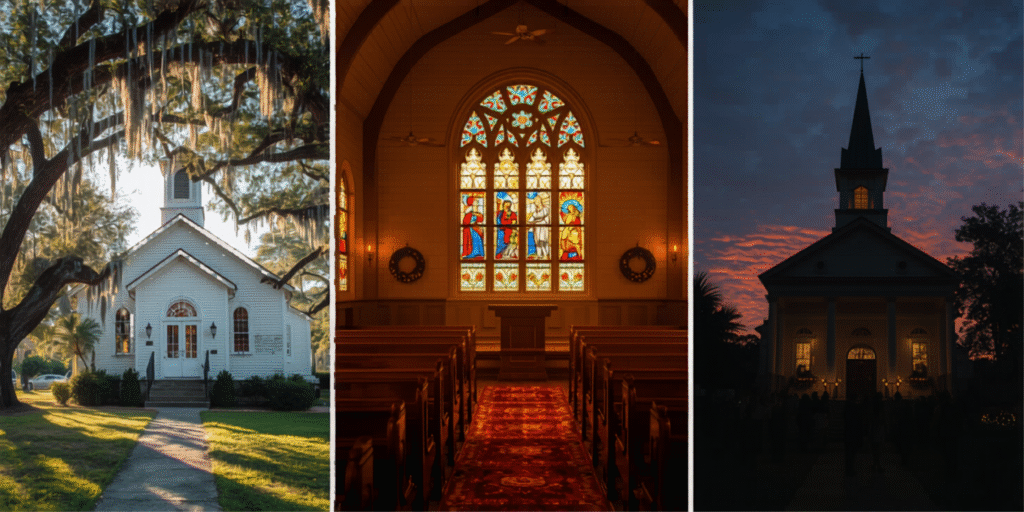
It might come as a surprise, but Easter is not celebrated by every Christian denomination. While it is the pinnacle of the liturgical year for the Catholic, Orthodox, and Anglican Churches, most Protestant denominations do not observe Easter or Holy Week in any formal, liturgical sense. For them, every Sunday is a celebration of the resurrection, so a special annual feast is considered unnecessary.
But for those of us who do celebrate it, the excitement is palpable. After the Palm Sunday teaser last week, we went shopping for new candles for the Vigil service. Maybe slightly adorned with some decorations, befitting the event. We look forward to the Exsultet, the beautiful proclamation of Easter. With nine scripture readings, the Easter Vigil is the longest service of the year. Even those church-goers who used to rant about the twenty-minute-long Sunday homily are eager for the service.
Whether Easter is your thing or not, the faith remains the same. Tonight, as those of us who celebrate join in the joyful vigil, let’s remember it is for the same Lord and let’s pray for each other, asking for grace to grow stronger in our faith.
02 Easter Did Not Start as a Christian Holiday
Long before it was a Christian celebration, Easter had pagan roots. The name itself is believed to derive from Eostre (or Ostara), a Germanic goddess of spring and fertility. Her festival was celebrated at the spring equinox, a time of rebirth, longer days, and the thawing of the earth after winter.
As Christianity expanded across Europe in the early centuries AD, the Church intentionally incorporated existing festivals rather than banning them. The Jewish Passover, which coincided with Jesus’ crucifixion and resurrection, conveniently aligned with pagan spring celebrations. Over time, the Christian interpretation absorbed and replaced the pagan significance. Remnants of old fertility symbols like eggs, rabbits, and flowers still persist.
What started as a celebration of the spring equinox, of nature waking up from its winter slumber, was transformed into the celebration of spiritual rebirth. It’s a beautiful metaphor, isn’t it? The world turning green again, just as we celebrate the promise of eternal life.
03 Holy Week: The Most Sacred Seven Days of the Year
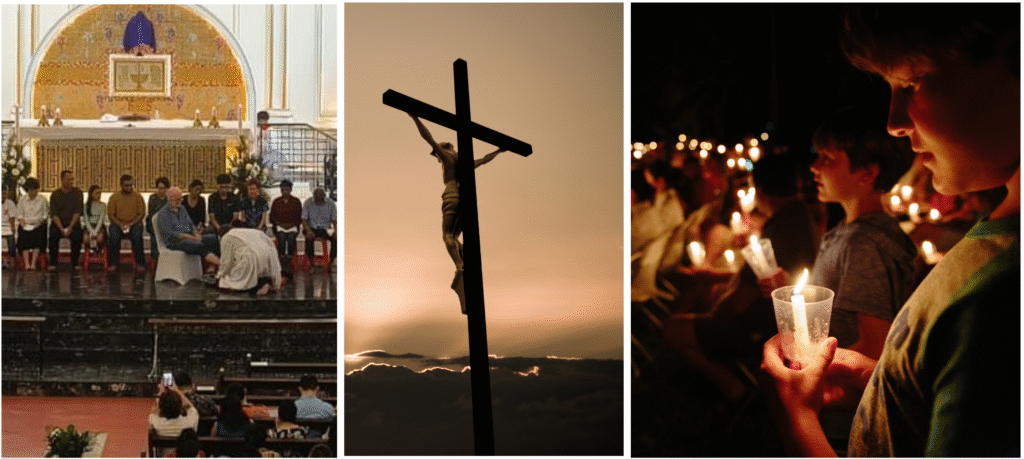
Holy Week is a spiritual marathon that begins with Palm Sunday, commemorating Jesus’ triumphal entry into Jerusalem. Then comes the transition into the Easter Triduum, the three-day period that marks the peak of the Christian liturgical year. It commemorates the Passion, Death, and Resurrection of Jesus Christ. While it spans three calendar days, it is liturgically celebrated as one single, continuous event.
Easter Triduum begins with Holy Thursday (also called Maundy Thursday), which commemorates Jesus’ final meal (the Last Supper) with his disciples and Jesus washing their feet. The twelve apostles, who were commissioned to spread the faith to the world, were first schooled on the essential lesson for discipleship: servitude. Service with humility. Unfortunately, this lesson is often forgotten by today’s Church leaders.
Then comes Good Friday, the solemn commemoration of the crucifixion and death of Jesus. Calling the day “good” seems strange given the solemn events it commemorates. But the name is based on historical language. In Old English, the word “good” was often used to mean “holy” or “sacred” just as the Holy Bible is often referred to the “Good Book.”
And finally, Easter Sunday itself: the resurrection and the explosion of joy.
Holy Week also marks the end of Lent, that long season of fasting, prayer, and penance that begins on Ash Wednesday forty days earlier. By the time Easter Sunday arrives, we have earned it spiritually.
04 How Easter’s Date Is Calculated: The Paschal Full Moon
Ever wonder why Easter moves around the calendar? Unlike Christmas, which is fixed on December 25, Easter is a movable feast. Easter falls on the first Sunday after the Paschal Full Moon, the first full moon on or after the spring equinox (fixed as March 21 in ecclesiastical calculations).
This system dates back to the Council of Nicaea in 325 AD, aiming to keep Easter tied to both the Jewish Passover and the solar calendar. The “Paschal” part refers to Passover, since Jesus’ Passion happened during that feast. So, the date can range from March 22 to April 25.
Yes, it’s a mix of astronomy and tradition.
Come to think of it, it’s a lovely reminder that our faith is rooted in both history and the natural rhythms of creation.
05 The Great Calendar Divide: Orthodox Easter
If you’ve ever noticed that your Greek or Russian friends are celebrating Easter a week or even a month later than you, you aren’t imagining it. Okay, some Catholics do, too. More precisely, those from the Eastern Rites, like the Ukrainian or Middle Eastern Catholic communities.
That is because these churches follow the Julian calendar rather than the Gregorian calendar used by most Catholic and Protestant Churches. The Julian calendar, introduced by Julius Caesar, runs about 13 days behind the Gregorian one, which was adopted by the Catholic Church in 1582.
These churches also follow slightly different rules regarding the Paschal Full Moon. Their tradition strictly states that Easter must occur after the Jewish Passover. As a result, their Easter can be delayed by one to five weeks.
But there are times when the Easter calculation aligns, and both Easters fall on the same date. For example, in 2025, both Easters occurred on April 20th. The next one is expected on April 16th, 2028.
06 The Miracle of the Holy Fire in Jerusalem
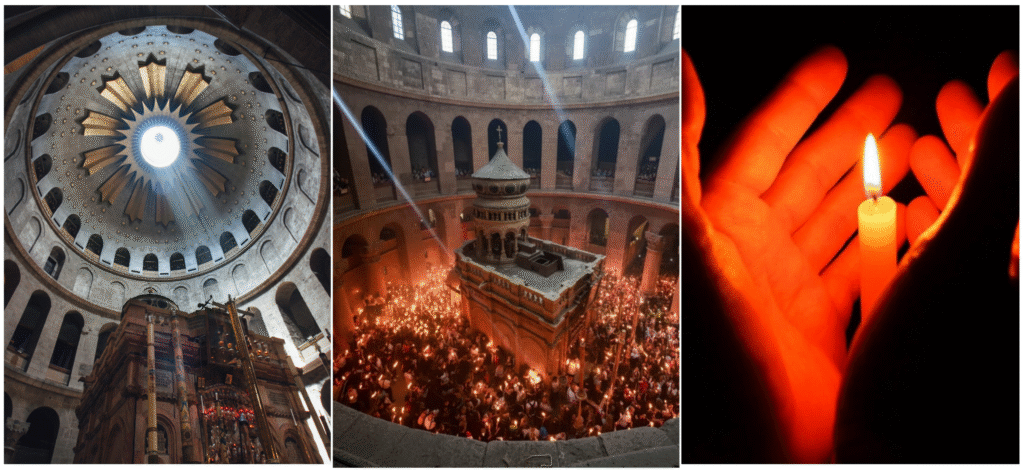
This is one of the most awe-inspiring (and controversial) traditions I’ve ever learned about. On Orthodox Holy Saturday service, in Jerusalem, at the Church of the Holy Sepulchre, a ceremony takes place that draws millions of believers.
It’s called the Miracle of the Holy Fire.
The ritual is intense. The Greek Orthodox Patriarch is first searched by authorities to confirm that he carries no matches, lighters, or other ignition sources. He then enters the small shrine enclosing Jesus’ tomb, alone. What happens next, according to millions of believers, is a miracle: a holy light spontaneously appears, igniting the candle he holds. The flame, described by the faithful as blue-white and non-burning in its first moments, is then passed from candle to candle throughout the packed church. Pilgrims wash their faces in it, claiming it does not burn skin. The miracle lasts more than half an hour.
The fire is then flown from Jerusalem by special charter flights to Orthodox communities around the world like Greece, Cyprus, Russia, Romania, and beyond, where it is received with deep reverence and used to light Easter candles in churches. Because the flame must arrive in time for the midnight Easter services, it is treated with the same urgency and honor as a visiting head of state.
Is it a miracle? Critics say the fire is lit by conventional means like a hidden lamp or a chemical reaction and describe it as a powerful but purely symbolic tradition. Believers, of course, see it differently. For them, the Holy Fire is a living sign of Christ’s resurrection, renewed every year.
Whether the Holy Fire is a “real” miracle is a matter of profound religious faith and significant historical and scientific debate. There is no consensus that satisfies everyone, as the event relies on personal belief versus critical investigation.
But honestly, whether you are a skeptic or a believer, there is something undeniably moving about a flame that has spontaneously emanated from the same place, in the same way, every Easter for almost two thousand years.
07 The Passion Play: From the Philippines to the World
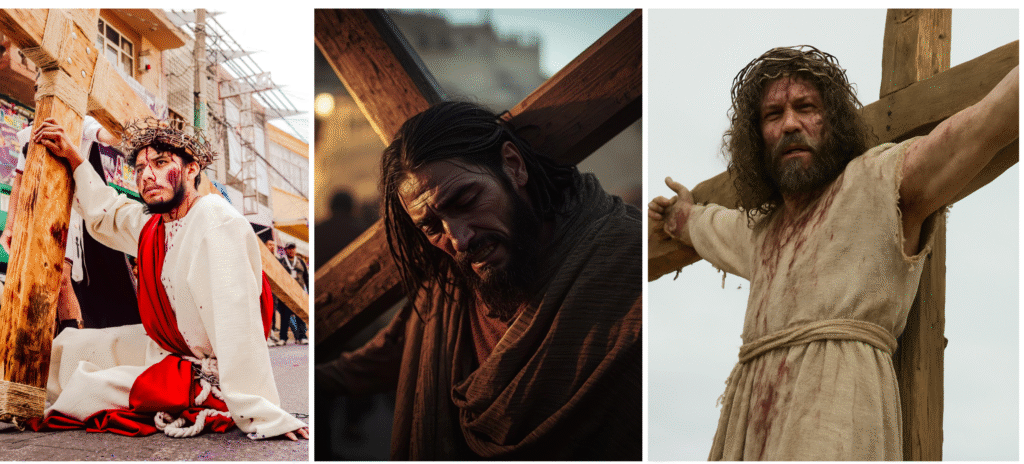
In the Philippines, Holy Week comes alive through the Senakulo, a traditional Passion play dramatizing Jesus’ suffering, crucifixion, and death. Performances range from elaborate stage productions to street reenactments.
In places like Pampanga, some devotees take it further with real flagellation and, in rare cases, actual crucifixions (nails through hands and feet). The Church discourages the most extreme forms but respects the deep piety behind them. Elsewhere, Passion plays are less graphic but equally moving.
The Philippines is far from alone. Passion Plays are performed across Latin America, Germany, Austria, Spain, and even the United States. The famous Oberammergau Passion Play in Bavaria, Germany, has been performed every ten years since 1634, a vow made by villagers who survived a plague. These theatrical traditions remind us that Easter is not just theology; it is story, drama, and lived human experience.
These traditions remind me how faith can be embodied so vividly. Watching or reading about them always makes me reflect on the cost of discipleship and the power of sacrifice in our own quieter lives.
08 Easter in Jerusalem: Walking Where It All Happened
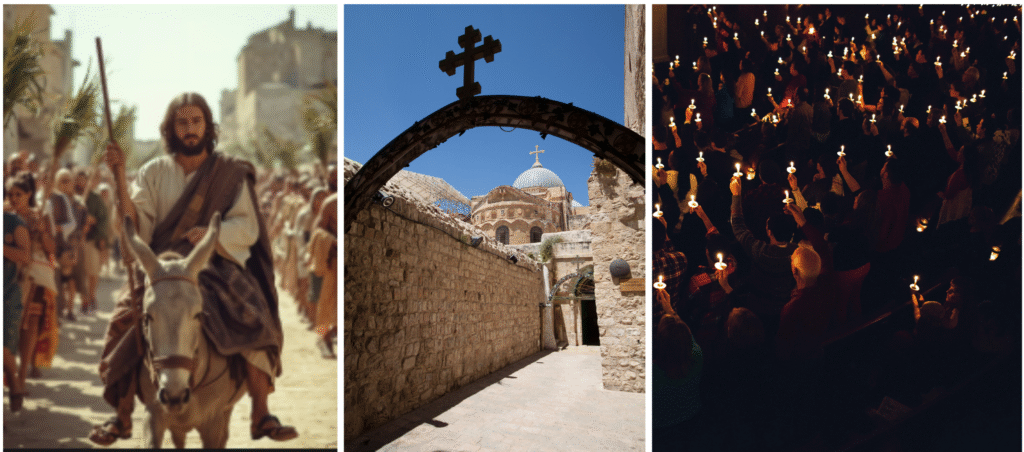
If there is a bucket-list Easter experience, it has to be celebrating in Jerusalem itself, the city where the events of Holy Week actually unfolded.
On Palm Sunday, pilgrims walk from the Mount of Olives down through the narrow, hilly streets toward the Old City, waving palm fronds and singing “Hosanna” — retracing the very path Jesus walked. On Holy Thursday, Mass is celebrated at the Basilica of the Holy Sepulchre, followed by the traditional Washing of Feet and a meditative Holy Hour held in the Garden of Gethsemane, where Jesus prayed before His arrest. The evening ends with a candlelit procession to the Church of St. Peter in Gallicantu, built over the site of the High Priest’s house where Peter denied Christ three times.
Speaking of the Washing of Feet, in the Vatican, the Pope traditionally washes the feet of 12 priests on Holy Thursday. In 2013, Pope Francis made headlines by breaking with centuries of tradition: he chose to wash the feet of women, Muslims, and disabled or imprisoned individuals. His message was clear: everyone is the people of God.
The washing of the feet always moves me; it exemplifies servant leadership in action. But the Pope’s gesture in 2013 made a deep impression on my heart, and I suspect, on many others as well.
The Basilica of the Holy Sepulcher is the center of Easter celebration, with six different Christian churches using the venue for their Easter Vigil services. These communities share the space under a complex set of historical rules known as the Status Quo.
The Catholic Vigil is first. It’s held early on Holy Saturday morning (typically around 6:30 AM or 7:30 AM) rather than at night. This makes Jerusalem the first place in the world where the Resurrection is liturgically announced.
Once the Catholic service concludes, the space is cleared for other rites. The Greek Orthodox typically celebrate their major “Holy Fire” ceremony and subsequent vigil later on Saturday afternoon and into the night.
09 The Original Easter Egg Artists Were Ukrainian
Let’s move to the less serious and more fun stuff.
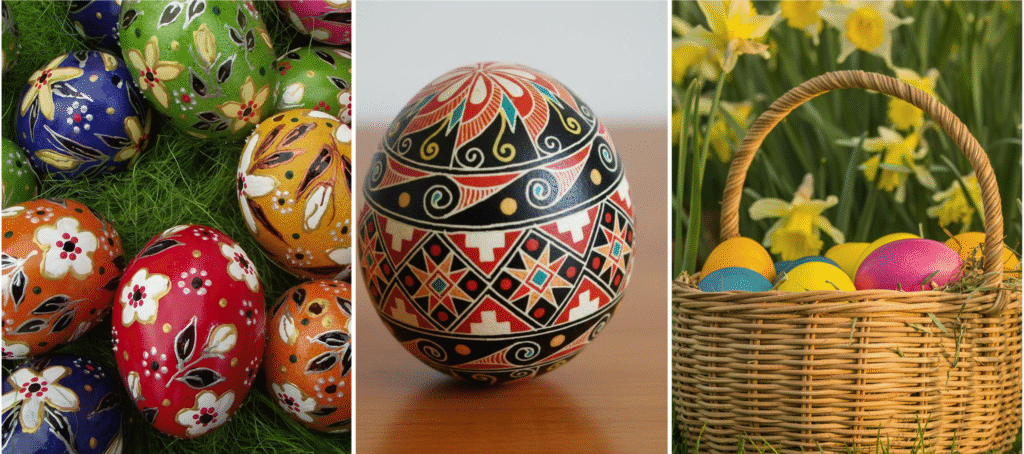
Long before the plastic eggs filled with jellybeans, there were Pysanka. These are incredibly intricate, hand-painted eggs from Ukraine. Ancient Ukrainians decorated eggs to honour gods of health and fertility, believing the egg’s symbolism of new life held spiritual power.
When Christianity came to Ukraine, the tradition was absorbed into Easter practice. The egg became a symbol of the resurrection, the sealed tomb that gives way to new life. Ukrainian pysanka are breathtakingly elaborate, using a wax-resist technique and natural dyes. Today, they are recognized as a genuine art form, and the tradition has spread worldwide.
There are over 100 distinct pysanka regional styles across Ukraine. The patterns, colors, and symbols on each egg carry specific meanings — a spiral for eternity, a deer for prosperity, the color red for passion and joy.
It’s fascinating how something so simple like an egg, can carry so much symbolism across cultures and time.
10 The Easter Bunny: Legend, Pagan Roots, and Modern Fun
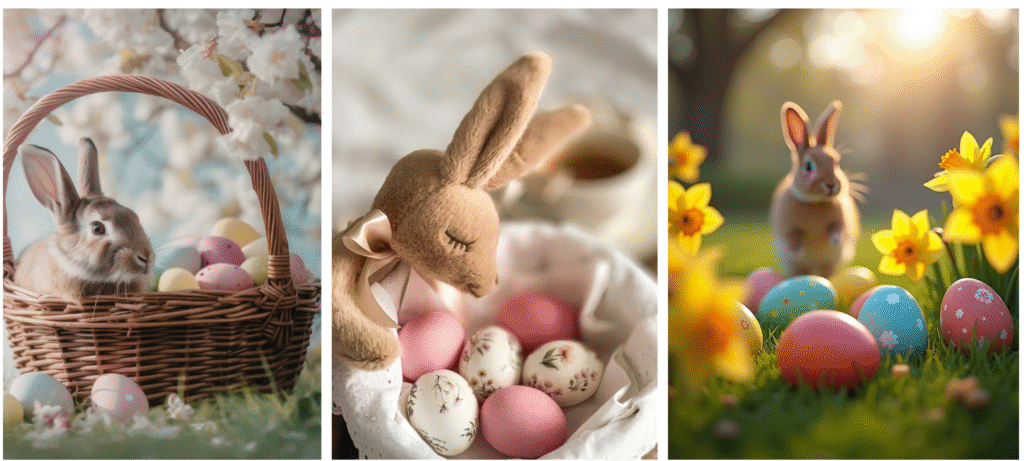
Finally, let’s talk about the fluffy guy. Where did the Easter bunny come from? The Bible certainly doesn’t mention a rabbit delivering chocolate.
Like the name “Easter,” the bunny likely has pagan origins. The hare was a symbol of fertility associated with the goddess Eostre. The tradition of the “Easter hare” first appeared in German literature in the 1600s.
German settlers brought the tradition to America in the 1700s, where the Osterhase would lay colorful eggs in nests made by children.
Today, it’s mostly playful, but I enjoy how even secular symbols can point back to themes of new life and joy. If we let them.
Final Thoughts
As I wrap up this post and get ready for the Vigil service, I’m reminded that Easter is a season of second chances. It’s a reminder that no matter how dark the “Good Friday” moments of our lives might feel, Easter Sunday is coming.
We all have tombs in our lives. Habits we want to break, sorrows we carry, fears that hold us down. Easter is when those stones can be rolled away.
So, wherever you are, whether you observe it with a solemn Mass, a grueling Passion Play, a basket full of chocolate, or simply a quiet moment of reflection, I wish you a truly blessed Easter filled with peace, renewal, and maybe even a little wonder.
Let’s carry the light forward. 🌿
Thank you for spending a little “after work” time with me. 💛Stay tuned for the upcoming blog article – arriving soon 🫰