Hey friends, welcome back.
How’s the weather in your part of the world? The El Niño heat and haze are almost unbearable in this little town of Miri. It’s been going on for months with no sign of getting better.
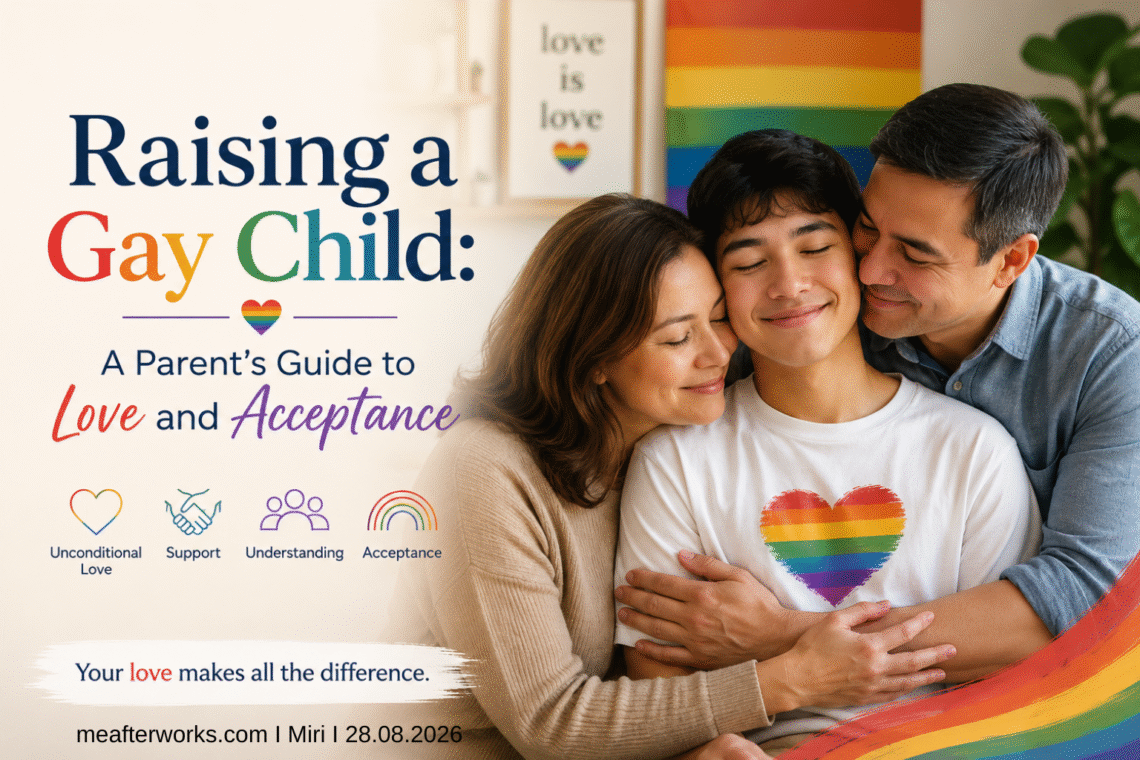
Today’s topic is about raising gay children. I don’t have a gay child, so I may be the least qualified to write this article. Still, I believe this is a fitting starting point for my new series on raising children who are “different.” The series is about raising awareness and offering advice to parents, especially traditional Asian parents, on issues like “losing face” that Western parenting books often overlook.
Here goes.
Introduction
You are standing when it happens. Kitchen counter, half-cut onions in front of you, phone in your hand, the words glare at you. Your only son has sent the message. A simple text. He’s gay.
You read it twice.
Your first thought: Why? Why? Why? What have I done to deserve this?
Then put the phone down and cry.
No, you’re not disgusted. And no, you don’t love your child any less in that moment. But in that split second, a hundred pictures you’d been quietly holding onto swim in your head. Wedding. Daughter-in-law. Grandchildren running around during festive celebrations. Now, you don’t know what the new picture looks like yet.
Whatever emotion you’re feeling right now is allowed. Shock, grief, confusion, anxiety. You worry about what people will say. None of these makes you a bad parent. It makes you human. What matters is what you do next.
I am not a counselor or religious scholar. There won’t be clinical stats or theological views here. I don’t believe that’s what you need right now, anyway. What you do need is honesty, perspective, and a reminder that love is bigger than fear.
If you’re reading this because you just found out, or you suspect, or you’re bracing yourself for a conversation you know is coming, grab a cup of coffee. This is exactly the read for you.
The Shock Is Real. So Is What Comes After.
In many families, this conversation isn’t easy.
We don’t raise our children in a vacuum.
Religious beliefs, cultural norms, grandparents, relatives, neighbors, school friends, and family friends all influence our children. You keep this new challenge to yourself, maybe even from your spouse. The biggest fear for Asian parents is “losing face.”
At Church service, you suspect every glance at your son, as they already know your situation and you wish you hadn’t come that day. After the service, you skip the friendly chat with the pastor and probably head straight home instead of joining the usual Sunday breakfast with friends and family.
What will people think? That question lingers in your mind. And you’re correct. Once the news spreads, almost everyone has an opinion, one way or another.
The initial reactions are often along the lines of, “Wahh, what a pity. He’s the only child.” You want an honest translation? It means judging your child with scorn for bringing shame to your family. I know this because I used to think the same way. I’m not proud of it, but that’s how our society is.
Over the years, through reflection and reading, I’ve realized how profoundly wrong my view was. But the sad truth is, we can’t escape society’s judging eyes.
You need a mental shift. You don’t owe anybody an explanation. You don’t! Prepare a short response in advance for those bold enough to ask. Trust me, there will be some. Something like, “He’s my child, and I love him. Whatever he is, he’s still my child.” You don’t need to debate, justify, or convince anyone. The people who matter will come around, in their own time. Or not at all. Either way, you’re not responsible for managing everyone else’s discomfort at your child’s expense.
When family members show unexpected kindness, accept it with gratitude. Today, people tend to be more understanding and accepting than in my past. Sometimes, this kindness comes from unexpected sources, like an aunt you thought would be strict, or a grandparent who simply says, “I just want him to be happy.”
Hold onto those moments. They’ll carry you through the harder ones.
Wrestling With Faith
I’m not going to pretend this is easy. In Malaysia, being gay is still a battle. Your child will face challenges you can’t protect him from. People will reject him, judge him, mock him, and make him feel less than. But nothing will be worse for your child than dealing with his faith.
I’m not here to tell you how to reconcile your faith with your child’s identity. That’s a deeply personal journey, and only you can walk that road. However, I will say this: no matter what you decide, your child still needs a safe home and loving parents. For most of us, faith is ultimately about love, compassion, and caring for those we are responsible for. You don’t need all the theological answers right now to decide to continue loving your child openly.
It’s not about abandoning your faith. It’s about choosing love. Unconditional love. The love that sees your child’s humanity. The love that says, “I will never stop being your parent.” Once you’re at peace with your decision, your child will feel more secure in his own faith journey.
On a personal note, spirituality is a private matter. It’s a personal relationship with God. Your child has every right to his beliefs and to the way he worships, regardless of his sexuality. We cannot be sure that God loves a gay child any less than a straight one. And who are we to judge or condemn them, anyway?
A Different Understanding
Here’s what I’ve learned.
If you ask a medical doctor why your child is gay, he will probably explain that it results from a complex combination of biological, genetic, and hormonal influences. This means your child is inherently different, similar to how a left-handed child is born with a natural variation.
Interestingly, several studies have identified several factors that may contribute to same-sex attraction. These include parental absence, in which children seek affection elsewhere; sexual abuse; placement in a single-gender school environment; and exposure to media influence. These studies claim that sexual orientation is not something fixed or biologically predetermined. It can change according to experience and environment.
Whether you believe orientation is fixed or fluid, the real question is: What does your child need from you right now?
The answer is always the same. Love.
Unconditional love. That’s what we signed up for when we became parents. We didn’t sign up to love our children only if they fit our expectations. We signed up to love them. All of them.
Moving Forward
This journey doesn’t end with acceptance. It continues.
It continues when your child brings home his first partner. It continues when he faces discrimination. It continues when you have to sit with your own discomfort and choose love anyway.
Some days will be hard. Some days, you’ll grieve the life you imagined your child would have. That’s okay. Hang in there! You’re not alone on this journey. There are other parents who are going through the same thing.
My prayer for you is that you find the strength to love your child unconditionally. That you find the courage to stand up for him. That you find the peace of knowing that love is never wrong.
Your child isn’t a problem to solve. He is a person to be loved.
And that love? It changes everything.
A Private Note for Parents: You Are Not Alone
If you need a safe, confidential space to ask questions, process your feelings, or seek professional counseling, these reputable regional organizations offer discreet support with zero judgment:
- In Singapore: Access professional family counseling and email support at [Oogachaga](https://oogachaga.com/).
- In Hong Kong: Reach out to the 24-hour [Tung Wah PRIDE Line](http://www.tungwahcsd.org/en/our-services/youth-and-family-services/family-and-child-welfare-services/PRIDELINE) for professional, multi-lingual family guidance.
- In Malaysia: Find safe mental health options and community guidance through [PLUHO and Jejaka](https://jejaka.org/).
- Further Reading: Explore the [Congregaytion Family Index](https://www.congregaytion.com/parents-families) for regional articles written specifically for Asian family dynamics.
Books reference:
- Coming Out, Coming Home: Helping Families Adjust to a Gay or Lesbian Child by Michael C. LaSala:
A highly respected qualitative study that examines how families from various multicultural backgrounds handle a child’s coming out.
- Coming Out Asian by placeholder_author_name (available on the Coming Out Asian Official Site):
This resource explicitly deconstructs why it is uniquely challenging for LGBTQ Asians to come out, placing a major focus on collectivism versus individualism.
- Loving My Gay Child: A Mother’s Journey to Acceptance by Sushma Agarwal:
Written by an Indian mother, this memoir captures the devastation, confusion, and ultimate transformation of traditional South Asian parents when their child comes out.
- When Children Come Out: A Guide for Christian Parents by Mark A. Yarhouse and Olya Zaporozhets:
Written by Christian clinical psychologists, this book reframes a child coming out from a “fear-based crisis” into an opportunity for deepening family relationships.
- Living Out Islam: Voices of Gay, Lesbian, and Transgender Muslims by Scott Siraj al-Haqq Kugle:
This book explores how individuals successfully reconcile their deep faith in God with their sexual orientation.
Thank you for spending a little “after work” time with me. 💛
Stay tuned for the upcoming blog article – arriving soon 🫰