It has been quite a season, hasn’t it? We were barely done wiping the ang pao money off our hands from Chinese New Year when — bam! — here we are, on the eve of Hari Raya Aidilfitri. Honestly, I love this about living in Sarawak. Our festive calendar never really stops. One celebration flows into the next, and if you live here long enough, you stop thinking of these as separate events belonging to separate communities. They are just… life. Our life.
Right now, as I type this blog, there is something quietly extraordinary happening around me. My Catholic and Anglican friends are deep in the final days of Lent, a season of reflection and fasting. My Muslim neighbors and friends have been in Ramadan, waking before dawn for sahur, holding fast through the heat of the day with grace and patience I genuinely admire. Two different faiths, two different forms of sacrifice, happening side by side on the same streets, in the same neighborhoods. This, to me, is Sarawak at its finest.
“Here in Sarawak, we don’t just tolerate each other’s celebrations, we genuinely look forward to them.”
And if you think that sounds like a nice sentiment, let me make it concrete: intermarriage between races and religions is a common thing here. It is entirely normal for a single family to have children celebrating Hari Raya, Gawai Dayak, Christmas, and Chinese New Year, all under one roof across the calendar year. One family, four celebrations, zero awkwardness. That is Sarawak.
And now, as Ramadan draws to its close and the first crescent of Syawal is sighted in the sky, the whole mood shifts. The fasting gives way to feasting. The reflection gives way to rejoicing. Decorative lights illuminate the fronts of houses. It is genuinely easy to spot a Malay home during Raya season; they are the brightest, most cheerfully lit ones on the street. Out in the kampungs, you might catch the boom of a bamboo cannon and the warm glow of pelita lamps along the driveways. These things are still very much a kampung experience. Here in Miri town, I suspect it is Chinese fireworks doing the announcing, as usual.
I am not Muslim, but I have celebrated Hari Raya in one form or another for most of my life, tucking into ketupat and curry at a neighbor’s open house, watching friends return home to their kampungs, marveling at families dressed in perfectly coordinated colors. It is one of my favorite times of year, without question.
So, before the big day arrives, I thought it would be fun to share some things about Hari Raya Aidilfitri in Malaysia, especially in our corner of Sarawak, that you might not know, or that you know but have perhaps never fully appreciated. Here are 10 fun facts about this wonderful celebration.
10 Fun Facts About Hari Raya in Malaysia
🏡 1. The “Open House” Tradition
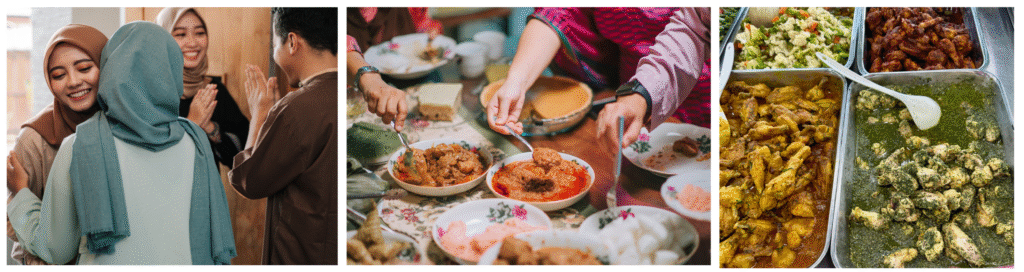
Malaysians, and especially Sarawakians, literally fling open their doors to everyone: friends, neighbors, colleagues, and complete strangers. Race, religion, none of it matters at the door. What makes Sarawak’s open houses particularly special is the spread on the table: it is not unusual to find roasted lamb, kacang-ma, or even bamboo chicken sitting alongside the rendang and ketupat. Just as a Chinese New Year open house here might feature Malay curries and native bamboo dishes, a Raya open house is a full Sarawakian feast.
The open house spirit extends beyond homes, too. Offices hold their own Raya celebrations where Muslim colleagues warmly invite their non-Muslim friends to share the joy, and our Premier hosts an official state open house that is truly a celebration for all.
🚗 2. Balik Kampung Rush
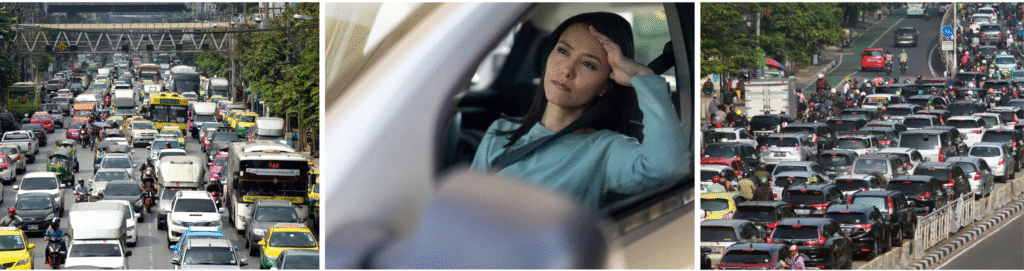
Millions of Malaysians make the annual pilgrimage back to their ancestral hometowns or kampungs, in what is essentially the world’s most determined traffic jam. Here in Sarawak, the Pan-Borneo Highway tells the whole story: it fills up with Muslims from Miri, our oil and gas town, making the long haul back to Bintulu, Sibu, and all the way to Kuching. The average journey takes about ten hours. And yet, every MPV and Toyota Hilux is packed to the roof with goodies, and I suspect quite a bit of firecrackers as well.
I can relate to that feeling as an Iban. I know exactly what it feels like to count down the days to Gawai Dayak, load up the car, and make that long drive back to our hometown for the annual harvest festival. The destination is different, the occasion is different, but that mix of anticipation, nostalgia, and belonging? Identical. Going home is the whole point.
💚 3. Green Packets (Duit Raya)
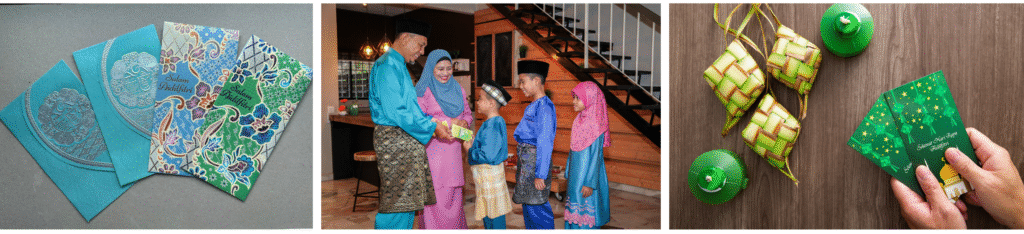
Inspired by the Chinese tradition of ang pao, Hari Raya has its own version: duit raya, given in green envelopes to children and the elderly as a gesture of generosity and blessing. And just like ang pao, the notes must be crisp and new, which means that in the weeks leading up to Raya, there is an absolute frenzy at the banks as people queue to exchange their old notes for fresh ones.
On Raya day, children of all races quickly catch on, of course. They position themselves strategically at open houses with their best smiles ready, smiles that are worth every ringgit inside the green packet. What I find particularly moving is the tradition of working children returning from the city to give duit raya to their grandparents, the most respected members of the family. A lovely reversal of the usual direction.
🎋 4. Lemang & Sarawakian Rendang
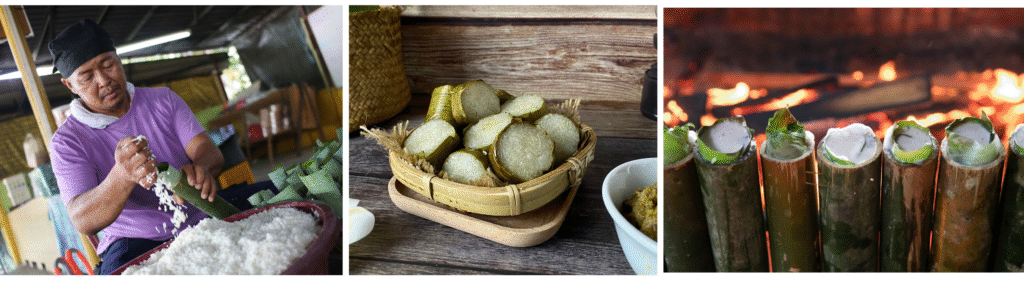
No Hari Raya table is complete without lemang, glutinous rice, and coconut milk slow-cooked inside freshly cut bamboo sticks over an open fire. The bamboo gives it a faint, smoky sweetness you simply cannot fake. Glutinous rice dishes are common across all races in Sarawak. The Dayaks have their own version of lemang, while the Chinese have chang, glutinous rice wrapped and steamed in bamboo leaves.
You can find one version or another throughout the year, but somehow they always taste better during a festive season. Maybe it is the company. Or maybe, and I genuinely believe this, the spirit of the season is the secret ingredient that no recipe can capture. And lemang’s perfect Raya partner? Beef rendang. Sarawakian rendang, in particular. It features a stronger turmeric flavor and is enriched with thinly sliced turmeric leaves, providing a distinctive, aromatic richness. Nothing quite beats it. (Disclaimer: to each their own, of course. ✌️)
🪔 5. Pelita: Lighting the Way
Traditionally, Malaysians placed pelita, Malay for kerosene oil lamps, along their driveways and garden paths during Ramadan to welcome the coming festival. These days, even in the kampungs, the traditional kerosene version has largely given way to solar-powered or battery-operated lamps. They are more practical, safer, and honestly more beautiful. What has not changed is the enthusiasm for festive lights: Malay houses during Raya are a sight to behold. In any neighborhood, you can tell exactly where the celebration lives by following the glow.
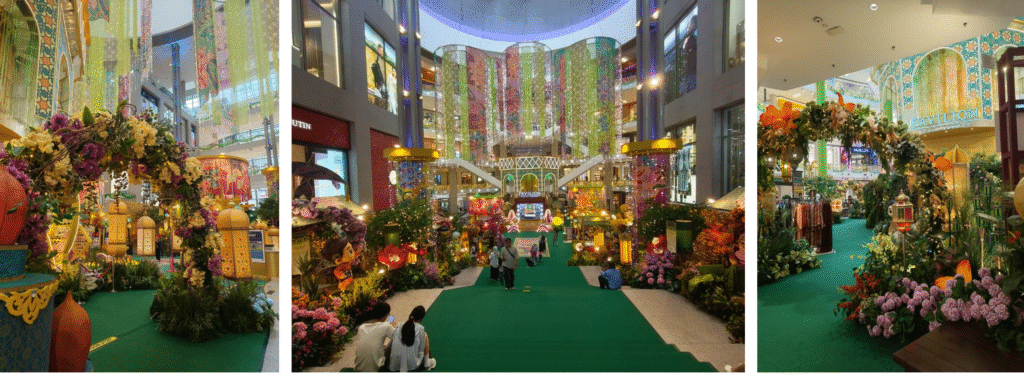
In Kuala Lumpur, the capital city, large malls compete to showcase the year’s best decorations. Hari Raya decorations usually follow a theme that blends modern and traditional elements, such as pelita and batik art. The yearly festive decoration battles begin with the most impressive Christmas displays, followed by the Chinese New Year, and now Hari Raya decorations. From Christmas in December through Hari Raya, Kuala Lumpur is spectacularly lighted with themed lights and decorations. Many tourists plan their visits during these festival seasons. If you haven’t visited Kuala Lumpur yet, I invite you to experience the multicultural celebrations and the breathtaking beauty of my country.
🎊 6. “Kongsi Raya”: The Double Celebration
Every so often, the lunar calendars align, and Hari Raya coincides with Chinese New Year. It is a rare and joyous phenomenon Malaysians call “Kongsi Raya” (a clever wordplay: kongsi means “share” in Malay) or sometimes “Gong Xi Raya.”
The phrase originally served as the tagline for Subang Parade, a department store in Subang Jaya, during the 1996 Chinese New Year and Hari Raya season. It was swiftly embraced by the media to describe the dual celebration. By 1997, the term had sneaked into the Malaysian vocabulary.
For a multicultural country like ours, it is essentially the festive jackpot. This double celebration is predicted to return between 2029 and 2031. When it happens, it will be celebrated on a grander scale, of course, befitting its double joy. My Malaysian friends, are you looking forward to this double celebration? If you’re still in the workforce during this time, you would love the four-day public holiday. Personally, I’m excited for the decoration war in action. Which mall could put together the best artistic mix of the two festivals?
🎁 7. Ketupat as Art & Staple
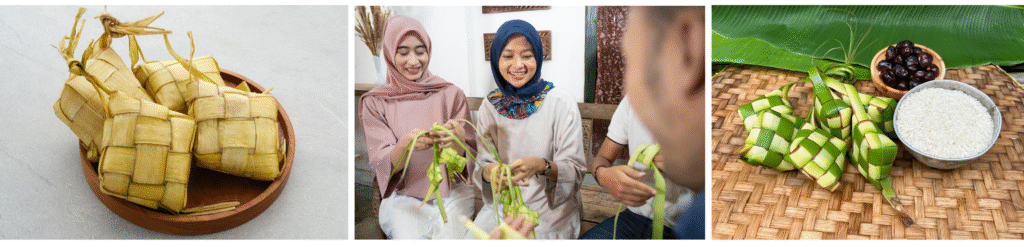
The diamond-shaped ketupat, a rice cake woven inside a casing of palm leaves, is so iconic that its woven ribbon pattern has become the default festive decoration in malls, shop windows, and homes nationwide during Raya season.
It is also, of course, an essential part of a proper satay dish. Funnily enough, the original hand-woven ketupat is increasingly rare these days; most families opt for the instant version made from pre-mixed rice ingredients.
The aesthetic lives on; the craft, quietly fading. Perhaps that is worth preserving.
📅 8. 30 Days of Festivity
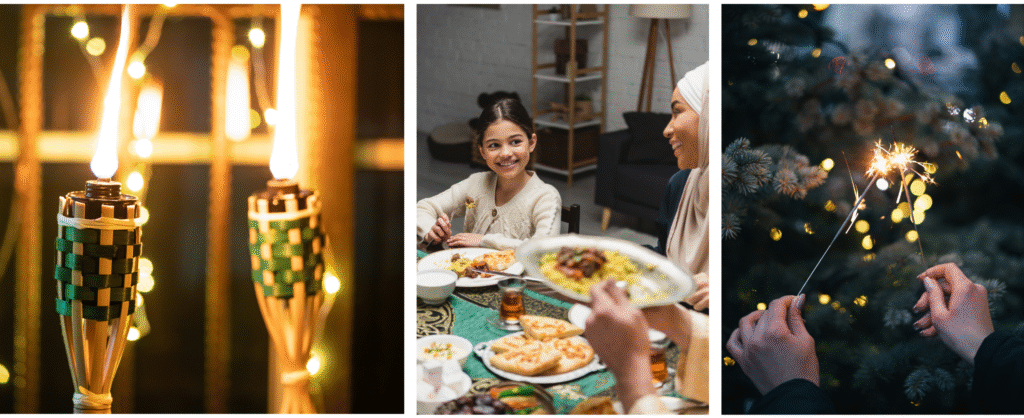
While the official public holiday lasts only two days, the Raya spirit extends throughout the entire month of Syawal, a full 30 days of open houses, visiting, and feasting. In the kampungs, the sounds of bamboo cannons can still occasionally be heard, and the driveways and houses remain brightly lit.
In this way, it fits perfectly into the Sarawak festive rhythm: Gawai Dayak lasts 30 days, closing ceremonially with the ngiling tikai; Chinese New Year lasts 15 days, culminating in Cap Goh Mei.
The first half of the year here is one long, joyful arc of celebration. From Christmas in December through to Gawai in June. Nobody in Sarawak has ever been in a hurry to end a good party.
👘 9. Color-Coded Families
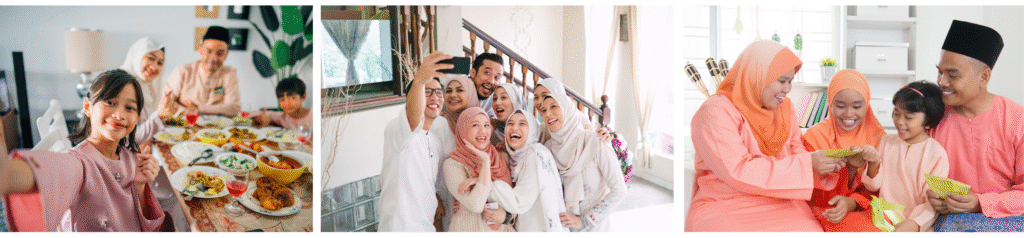
Coordinating the whole family in matching Baju Melayu and Baju Kurung in their chosen color theme has become a popular modern trend. I’m not sure when or who started it, but it’s now a must-have on the Raya checklist. Grandparents to toddlers dressed in the same color and fabric.
In West Malaysia, this trend has reached spectacular heights: there are families who coordinate not just their outfits but their furniture and curtains to match the chosen Raya color of the year. Here in Sarawak, we tend to be a little more relaxed about it. But the spirit is there, even if the curtains are left out of the discussion.
💥 10. Bamboo Cannons (Meriam Buluh)
In kampungs, the arrival of Hari Raya is sometimes announced with the thunderous boom of meriam buluh — handmade bamboo cannons that can be heard from miles around. In towns and cities, Chinese fireworks tend to do the job instead. But out in the villages, the meriam buluh is something else entirely.
When I went digging for its origins, I was genuinely surprised. I had always assumed it borrowed from the Chinese practice of using firecrackers to chase away evil spirits, but the story is richer. In some villages, the booms originally served a very practical purpose: scaring off wild animals from the surrounding forest to keep the community safe.
There is also a popular theory tracing the tradition back to 16th-century Portuguese artillery, which over the centuries transformed from an imitation of a war weapon into something far warmer: a deeply cherished, though often illegal, community ritual. Villagers form teams and fire their cannons in what can only be described as a coordinated artillery battle that goes on until dawn. Children as young as nine join young adults returning from the cities, ensuring that the craft and its thunderous joy are carried forward. Just as the Chinese New Year feels incomplete without firecrackers, Hari Raya simply would not be the same without the meriam buluh. It is loud, it is proud, and it means something: some traditions refuse to go quietly — literally.
Final Thoughts
As I wrap up this post on the eve of Hari Raya, I find myself in that particular mood that only certain celebrations can bring — a kind of quiet joy mixed with giddy anticipation. Tomorrow, my Muslim friends and neighbours will wake before sunrise for Subuh prayers, dressed in their finest, and begin a day filled with visits, food, forgiveness, and family. And many of us non-Muslim Sarawakians will be right there with them at some point during the day, tucking into rendang and lemang.
This is the Sarawak I love. This is the Malaysia I am proud to live in. Not a perfect place — no place is — but one where, on the eve of a great celebration, you can hear the hum of anticipation from every household on the street, regardless of whose celebration it technically is.
To my Muslim readers everywhere, to my dear sister Nurshakila and her family, to Muslim relatives and friends near and far — may this Hari Raya be filled with the warmth of family, the richness of good food, the sweetness of forgiveness asked and given, and every good thing you deserve.
And if there is a plate of Sarawakian rendang at your open house, you know where to find me. 😄

Thank you for spending a little “after work” time with me. 💛
Stay tuned for the upcoming blog article,”The Art of Letting Go: Finding Peace in a World That Clings” arriving on Monday, 23rd March 2026 🤞🫰


So fun to read and so apt!
Thanks for bringing a smile to my face and making me appreciate my Sarawakian and Malaysian roots more! 🥰
Thanks Sheh Hwa. Will try to write more interesting stuff now that I’m retired.