Hey friends, welcome back.
How’s the weather where you are? The weather has been pretty kind to Mirian these days. The El Niño and haze situation has improved considerably.
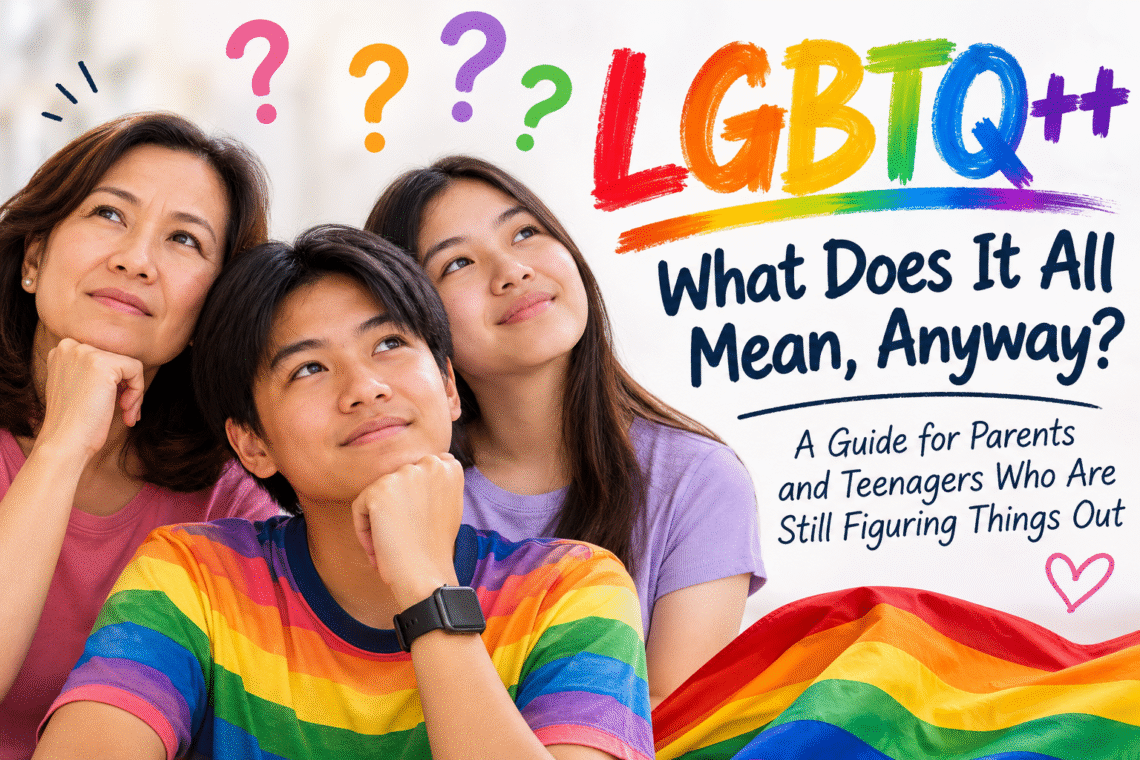
The last article I wrote sparked so much interest that I decided to write a follow-up. I heard from parents who felt lost in the acronym soup and weren’t sure how to tell whether their own kids might be gay. I also heard from teenagers trying to make sense of their feelings, perhaps hoping that naming them would make everything a little less confusing.
I thought that was rather telling.
Here we have parents worried because they don’t understand their children, and teenagers worried because they don’t understand themselves. Both sides are struggling, but for very different reasons.
This is a sensitive subject, so I’ll do my best to stick to the facts and avoid making personal comments.
But first, a brief disclaimer: I’m not a psychologist or sexuality expert. I’m simply a mother and writer hoping to help parents better understand their children.
And if you are a parent reading this expecting to find out if your child might be gay, please take a deep breath. This article is not a checklist for identifying a gay child.
If you are a teenager reading this, wondering whether you might be gay, bisexual, transgender, or something else, I hope you will find some answers here.
Here goes. Grab a cup of coffee.
So, What Does LGBTQ++ Mean?
Let’s begin with the alphabet soup!
LGBTQ+ is an umbrella term for people whose sexual orientation or gender identity may differ from what society traditionally expects. The letters stand for:
- L – Lesbian: A woman who is romantically, emotionally, or sexually attracted to women.
- G – Gay: Someone attracted to people of the same gender. The word is commonly used for men attracted to men, although people of other genders may also identify as gay.
- B – Bisexual: Someone who can be attracted to more than one gender. This doesn’t mean they must be equally attracted to men and women, or that they must have dated both.
- T – Transgender: Someone whose gender identity differs from the sex they were assigned at birth. This is about who they are, not who they love.
- Q – Queer or Questioning: Queer is an umbrella word for anyone outside heteronormative norms. Questioning means still figuring it out. If you’re a confused teen, this letter might be you. And that’s perfectly fine.
And what about the + sign?
The + acknowledges that no list of letters can ever include everyone.
The Long Version: LGBTQQIP2SAA
If you’ve been baffled by this monster of an acronym, here it is, letter by letter:
- LGBTQ: as above, with the additional Q representing “Questioning”
- I – Intersex: People born with physical sex traits that don’t fit typical definitions of male or female
- P – Pansexual: Someone who can experience attraction to people regardless of their gender
- 2S – Two-Spirit: A term used by some Indigenous North American communities for people who carry both masculine and feminine spirits. This term is not to be used casually for people from other cultures.
- A – Asexual: Someone who experiences little or no sexual attraction. Asexual people can still experience romantic attraction and have meaningful relationships.
- A – Androgynous: Someone whose gender expression sits between masculine and feminine. Depending on the organization, the A’s may be interpreted differently, including as asexual, aromantic, or ally. Androgyny is also not necessarily a sexual orientation or gender identity.
Confused already? Don’t worry. I don’t expect you to memorize every letter.
How Gay Became LGBT
Believe it or not, “gay” once meant joyful and carefree. Over time, some communities began using it as a quiet code for homosexual people. Before then, the words people used were often clinical, or simply cruel.
Things began to change after the Stonewall uprising in New York in 1969, which many consider the start of the modern gay rights movement. In the 1970s, gay was often used as an umbrella term, but many women felt left out. As a result, “gay and lesbian” became more common. Bisexual people spoke up, and the acronym expanded to LGB. Transgender people, who had been part of the movement from the start, were formally included, and by the 1990s, LGBT had become standard. The order was even changed from GLBT to put women first. Then, in the 2000s, the Q was added, followed by the + sign.
See the pattern? Each new letter was someone saying, “We exist, too. Please include us.”
What Do the Rainbow Colors Mean?
The rainbow flag was designed in 1978 by San Francisco artist Gilbert Baker. His original version had eight stripes, each with a meaning: hot pink for sexuality, red for life, orange for healing, yellow for sunlight, green for nature, turquoise for art and magic, indigo for serenity, and violet for spirit.
Because of fabric shortages, hot pink was dropped, and turquoise and indigo were merged into one blue. That gave us today’s six stripes. In 2017, Philadelphia added black and brown stripes to recognize LGBTQ people of color. In 2018, the “Progress Pride” flag added the colors of the transgender flag.
But why a rainbow?
Perhaps because no single color can represent the whole community. People are different, and those differences don’t have to make them enemies.
I think.
Hmm…I rather like that idea.
What Does “Woke” Mean?
Until recently, I thought “woke” was a new buzzword for LGBTQ people. I was that ignorant, but I’m sure I’m not alone. Did you know?
The word has become something of a political football. Depending on whom you ask, it can mean being socially aware or being excessively politically correct.
“Woke” began in African American communities as a way of saying people should stay “awake” to racial injustice. Over time, its meaning broadened to include awareness of social injustice more generally, including discrimination against LGBT people. That’s why the two are often discussed together: many LGBT rights campaigns are part of the wider social justice movement.
Today, supporters proudly use “woke” to describe caring about fairness. At the same time, some people use the word critically, believing that certain progressive ideas have gone too far. They may use it to refer to what they see as excessive political correctness or pressure to embrace particular social views.
So, the next time you hear someone use the word, ask what they actually mean.
For me, the more helpful question isn’t whether someone is woke or unwoke. It’s whether we can disagree with one another while still treating each other with respect. No humiliation, no discrimination, and no denying anyone their basic dignity.
We don’t have to agree on every social or political issue to treat one another with kindness and respect. And understanding a term doesn’t mean you have to adopt it as your own belief. It simply means you understand what people are talking about.
One thing I’d like parents to remember: being gay is not a political stance. It’s simply part of who a person is.
Common Myths: Do Gay Men and Lesbians Not Like Each Other?
I have a girlfriend who’s a lesbian, and we go to a gym that happens to be full of gay men. I noticed she doesn’t seem interested in joining their social circle, which surprised me because I’d assumed gay people naturally gravitate toward one another.
I asked, “Do gay men and lesbians not like each other?” She hadn’t considered it before. She suggested it might be because they’re two different groups of people who may follow different paths in life.
So, I guess the answer is: Not really. It’s mostly a stereotype!
Here’s the funny side to the story about my lesbian girlfriend. I have another friend, an Italian guy, and the two of them are like cats and dogs. They bicker and argue, and, long story short, they can’t stand each other. My Italian friend has moved back to Milan, and I recently found out from one of his Instagram posts that he’s come out.
So, I’m rethinking my earlier answer 😅😅
But seriously, lesbians and gay men are just like anyone else. Some people get along wonderfully, while others may not see eye to eye. They may have different social circles, interests, or dating experiences, and that’s perfectly okay. There’s no natural hostility between them.
In some places, gay men and lesbians move in different circles, so they may not have as many opportunities to build friendships. In other settings, they form close bonds and support one another.
The healthiest lesson for young people is this: judge people by their character, not by their label.
Gay Terms You May Come Across
A quick glossary. Some terms are about intimate matters, so I’ll keep it light.
- Pride: Celebrations (usually in June) that honor LGBT people and their history. The idea is the opposite of shame.
- Pronouns: The words someone uses for themselves (he/him, she/her, they/them).
- Ally: A person who isn’t LGBT but stands with those who are.
- Coming out: Telling others about your orientation or gender identity. Closeted means you haven’t.
- Outing: Revealing someone’s LGBTQ+ identity without their consent. This can be harmful and should never be done.
- Non-binary: Someone whose gender identity does not fit exclusively into the categories of man or woman.
- Straight and cisgender: A person who is attracted to the opposite gender and has a gender identity that matches the sex assigned at birth.
- Heterosexual: (informally known as straight or hetero) A person who has an emotional, romantic, or sexual attraction to people of the opposite sex; typicallyrefers to a man being attracted to a woman, or a woman being attracted to a man
- Top, bottom, vers: Informal terms sometimes used in gay male relationships to describe preferred roles in intimacy. They are sexual terms, not personality types.
A gentle reminder for parents: knowing a word and having permission to use it to label your child are two different things. Understanding the vocabulary can be helpful, while your child’s identity is theirs to define.
Parents, How Do You Know If Your Child Is Gay?
Honestly? You can’t tell by looking.
There’s no checklist.
Quiet, sporty, artistic, or outgoing. Anyone could be gay or straight. Avoid stereotypes; they can cause misunderstandings and hurt feelings.
Make home safe and welcoming. Don’t pressure your child to “confess.” Show through everyday comments about gay people on TV, news, or jokes that your love is unconditional. If they’re gay, they’ll share when ready; if not, they’ll still know they can trust you.
And if they do tell you? Listen first. Thank them for trusting you. Save the questions for later.
Why the Silence Is So Heavy
Here’s something we have to say out loud.
In many Asian households, being gay remains taboo and rarely discussed. When it is, the response may be silence, shame, or the dreaded question, “What will people think?” Pressure to preserve face and family honor, marry, and have children can feel even heavier alongside religion and tradition.
Imagine being fifteen, noticing feelings you have no words for, and believing the people you love most may not accept them. That’s a lonely place. Many young people sit in it alone for years.
If that’s you, I want you to know the fear is real. It’s not a sign that something is wrong with you.
To the Teenagers
Let me speak to you directly.
First, being confused is normal. Adolescence is for figuring things out. Not having the answer yet is not failing.
- You don’t need a label right now. Names are tools, not deadlines. Your understanding may change, and that’s okay.
- Your feelings aren’t wrong. Attraction isn’t something you choose, and it isn’t something you did.
- Don’t rush to come out. Think about your safety, emotional and physical, and your home situation. Being open can carry real risks. Your story is yours to tell, when you’re ready.
- Find one safe person. A trusted friend, a counselor, a relative, a teacher. Carrying this alone is the hardest part.
- Be careful online. There are good communities and good information out there, but not everyone online is who they claim to be. Don’t share personal details or meet strangers without thinking twice.
- Look after your mind. If you feel hopeless, or you’re thinking of hurting yourself, please tell a trusted adult or call a local helpline right away. You deserve support. You are not alone.
Final Thoughts
When I started this series, I thought I was writing for parents. Your messages showed me I’m also writing for children who need to hear that nothing is wrong with them.
Whether you’re a parent trying to understand or a teenager still searching, my wish is the same. That every child grows up knowing they’re loved just as they are.
If you have questions or a story you’d like to share, write to me. I read every message.
You don’t need all the answers. You only need to keep listening.
Until next time, take care.
Thank you for spending a little “after work” time with me. 💛
Stay tuned for the upcoming blog article – arriving soon 🫰